
Belle & Sebastian
95 mins
A film conveying the message that sin begets more sin unless a person embarks on a path of repentance. A story about a family in which every one of God’s commandments is gradually broken. Ultimately, God is rejected as the culprit for the suffering that the people have brought upon themselves.
A father with two adult sons decides not to return the money he owes. He even decides to perjure himself and give false testimony in court, just so that the money he embezzled years ago remains in his possession.
Many people, however, suspect the truth. The same is true of his sons. In their eyes, the father loses even the last remnants of authority he had. The father’s bad example also influences his sons.
As a result, one son seduces his brother’s wife, who subsequently becomes pregnant with an illegitimate child. Ultimately, the brother kills his brother—again because of the money, which was a major catalyst for the family’s entire descent into ruin.
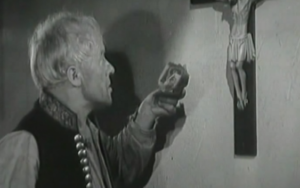
When the father sees where all this evil has led his entire family, he begins to blame God Himself for everything. Meanwhile, he asks—rather absurdly—what God is actually punishing him for. In his hatred, he removes the cross from his house and carries it to the barn, where he sets it on fire.
A poignant film highlighting the tendency to blame God for so much suffering, a tendency in which people lack basic self-reflection. People’s inability to admit to themselves that they are responsible for much of the pain in their lives is intertwined here with compromises with sin, selfishness, pride, and the exclusion of God from their lives.
Although the portrayal of human failings in this film is somewhat exaggerated, the plot does not come across as unrealistic or awkward in any way. The film essentially depicts violations of all of God’s commandments.
Czechoslovakia, 1938
Crew: Václav Wasserman;
Cast: Karel Černý, Ladislav Boháč, Karel Beníško, J. O. Martin, Marie Pilská, Jiřina Štěpničková, Miroslav Kryštof-Kutina, Běla Tringlerová, Karel Veverka, Alois Dvorský, Otto Zahrádka, Ferenc Futurista, Slávka Doležalová-Kulhavá, Jan W. Speerger, Máňa Hanková;
Parents’ Guide:
Extramarital affair. About three instances of lovers kissing.
Suffocation of a brother. A few instances of fighting between brothers.
Various forms of the father’s caresses.
Village men smoking and drinking at the tavern.
Theft, perjury, disrespectful handling of a cross.
It is worthwhile to support quality art by purchasing it. Supporting good cinema not only helps in the creation of high-quality films but is also an expression of honesty and decency toward the filmmakers.

There are no reviews yet.